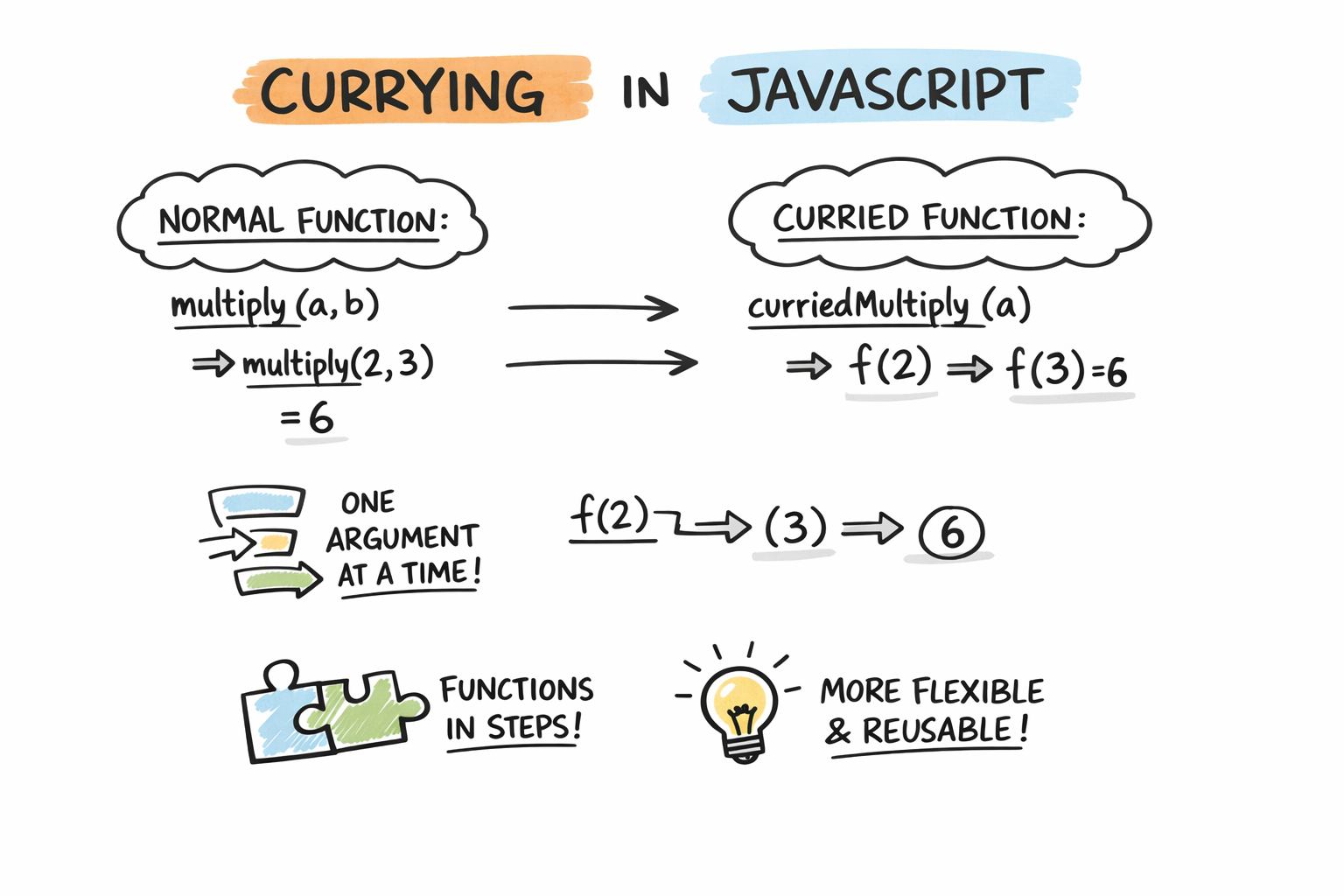
In this post, I want to keep things simple: what currying is, how it relates to partial application, and why it can be useful in real JavaScript code.
What is currying?
Currying transforms a function of many arguments into a chain of one-argument functions.
// uncurried
const add = (a, b) => a + b;

// curried
const addC = a => b => a + b;
Instead of passing all arguments at once, you pass them one at a time. Each call returns a new function that waits for the next argument until the final result can be produced.
A small example makes it easier:
const add = a => b => a + b;
// The you can call it like this:
add(2)(3); // 5

// Or you can partially apply it:
const increment = add(1);
const add5 = add(5);

// And call it later:
increment(4); // 5
add5(10); // 15
Currying vs partial application
These ideas are related, but they are not the same. I used to blur them together, so it is worth separating them clearly. Currying changes the shape of a function. Partial application uses that shape to pre-fill some arguments and get back a more specific function.
Here is a simple example:
const multiply = a => b => a * b; // curried function

const double = multiply(2); // partial application

double(5); // 10
multiply is curried because it takes one argument at a time. double() is the result of partial application because
we fixed the first argument to 2 and got back a more specific function.
Why this is useful
The main thing I like about currying is that it helps me build small reusable functions from more general ones.
const replace = regex => replacement => str => str.replace(regex, replacement);

const replaceSpaces = replace(/\s+/g)("-");

replaceSpaces("functional programming in js"); // "functional-programming-in-js"
This is useful when you want to configure a function once and then reuse it in several places without repeating the same arguments over and over.
Exercises
1. Curry multiply
Convert this multiply function to curried form:
const multiply = (a, b) => a * b;
Show answer
const multiply = a => b => a * b;
2. Curry replace
Convert this replace function to curried form:
const replace = (regex, replacement, str) => str.replace(regex, replacement);
Show answer
const replace = regex => replacement => str => str.replace(regex, replacement);
3. Explain the first application
Explain in your own words:
- What does
multiply(2)return? - Why is that useful?
Show answer
multiply(2) returns a new function that is still waiting for the second argument (b).
That is useful because it gives you a reusable function for a more specific job, for example:
const double = multiply(2);
double(5); // 10
Checkpoint
You are ready to continue when you can quickly convert between uncurried and curried forms, and explain how partial application is related but different.