Higher-order functions for currying in JavaScript
Sharpen Currying Skills
4 parts- Higher-order functions for currying in JavaScript
- Predicate Functions in JavaScript
- Currying in JavaScript
- A Simple Currying Refactor: Remove Pass-Through Arguments
I’ve been working on my functional programming skills and applying what I learn in real JavaScript projects. JavaScript is a great choice for FP because it fits the paradigm well, has helpful libraries, and still lets me fall back to familiar patterns when I hit a knowledge gap.
While practicing currying, I noticed something: I can read it and understand it, but refactoring existing code to use currying and partial application still feels awkward. So I decided to collect the concepts that make that refactoring process more intuitive. There are thousands of great resources on these topics, but I wanted a micro-curriculum that matches my learning style and maybe helps others too. The first concept is higher-order functions, which is the foundation for currying and composition.
Goal: Understand functions as values and function-to-function interaction.
What is a higher-order function?
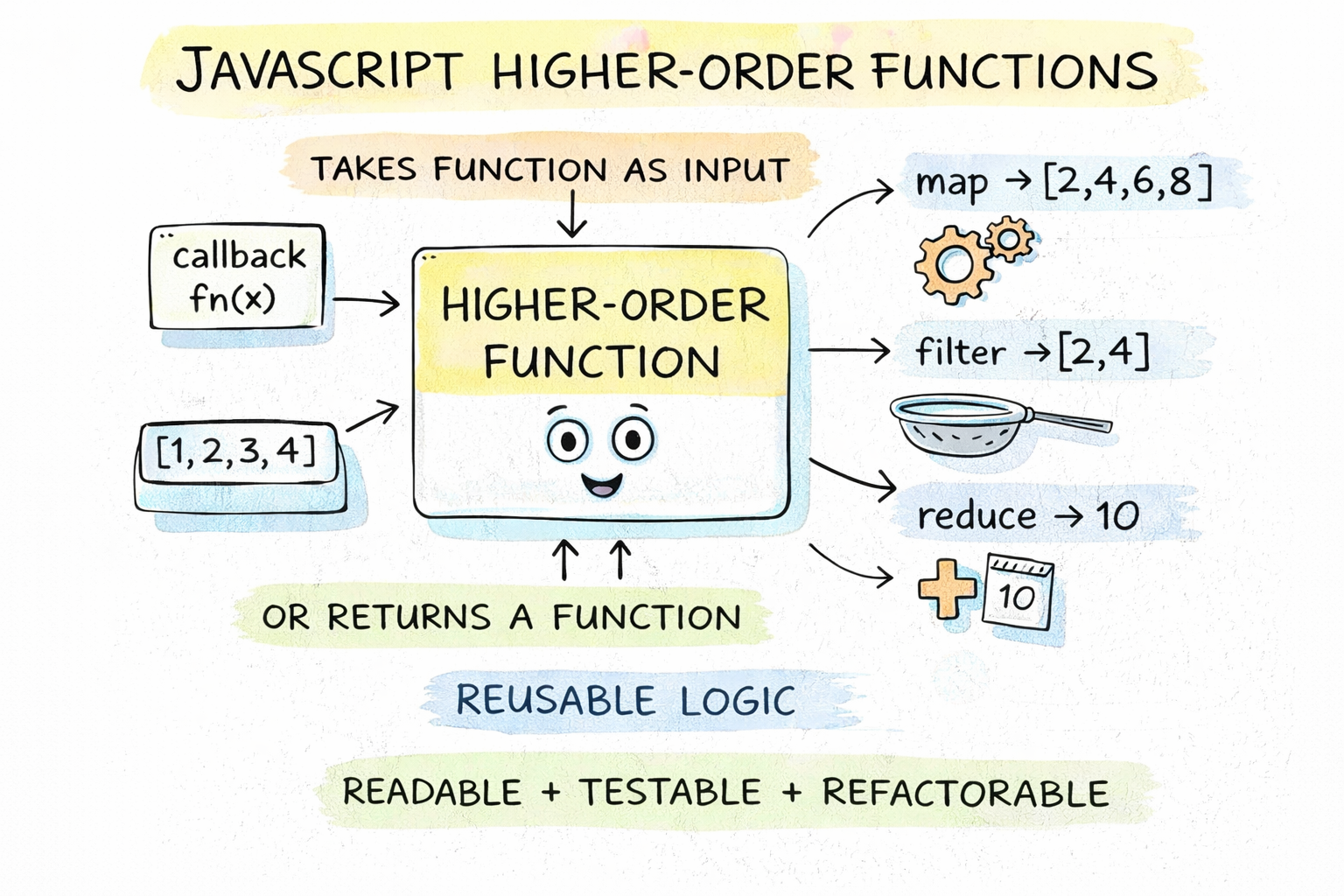
A higher-order function (HOF) is any function that takes a function as an argument, returns a function, or both. Functions that do neither are called first-order functions.
A good example of a HOF is
Array.prototype.map(),
which takes a function as an argument and applies it to every element of the array, returning a new array with the
results.
// This is a simple function that doubles a number
const double = x => x * 2;
// We can pass the `double` fn to `map`. This makes `map` a HOF.
const doubledNumbers = [1, 2, 3].map(double); // [2, 4, 6]
Here is another example of a HOF that returns a function:
// This is a HOF that returns a function
const createMultiplier = factor => {
  return x => x * factor;
};

// We can use the HOF to create a new function that multiplies by 3
const triple = createMultiplier(3);

// Now we can use the `triple` function to multiply numbers by 3
triple(5); // 15
Why this matters for currying
Currying becomes much easier when you are comfortable with functions as values. A curried function is just a function that keeps returning functions until it has all the arguments it needs.
const add = x => y => x + y;

const add10 = add(10);
add10(5); // 15
If that pattern feels natural, currying and partial application stop feeling magical and start feeling practical.
For now, don’t worry about mastering currying in this post. We’ll focus on higher-order functions first, then cover currying properly in a separate post.
Exercises
1. Apply twice
Write a function applyTwice that takes a function and a value, and applies the function to the value twice.
View answer
You can implement applyTwice like this:
const applyTwice = (fn, x) => fn(fn(x));
Here is an example of how to use applyTwice:
const increment = x => x + 1;
applyTwice(increment, 5); // 7
2. Build mapWith
Implement mapWith using Array.prototype.map.
View answer
const mapWith = (fn, xs) => xs.map(fn);
Usage example:
const increment = x => x + 1;
mapWith(increment, [1, 2, 3]); // [2, 3, 4]
Checkpoint
You are ready to move on when you can explain why each of map, filter, and reduce are higher-order functions.
If this helped, leave a reaction so I know this series is useful, and comment with the FP topic you want next while we prepare the dedicated currying post.