Predicate Functions in JavaScript
Sharpen Currying Skills
4 parts- Higher-order functions for currying in JavaScript
- Predicate Functions in JavaScript
- Currying in JavaScript
- A Simple Currying Refactor: Remove Pass-Through Arguments
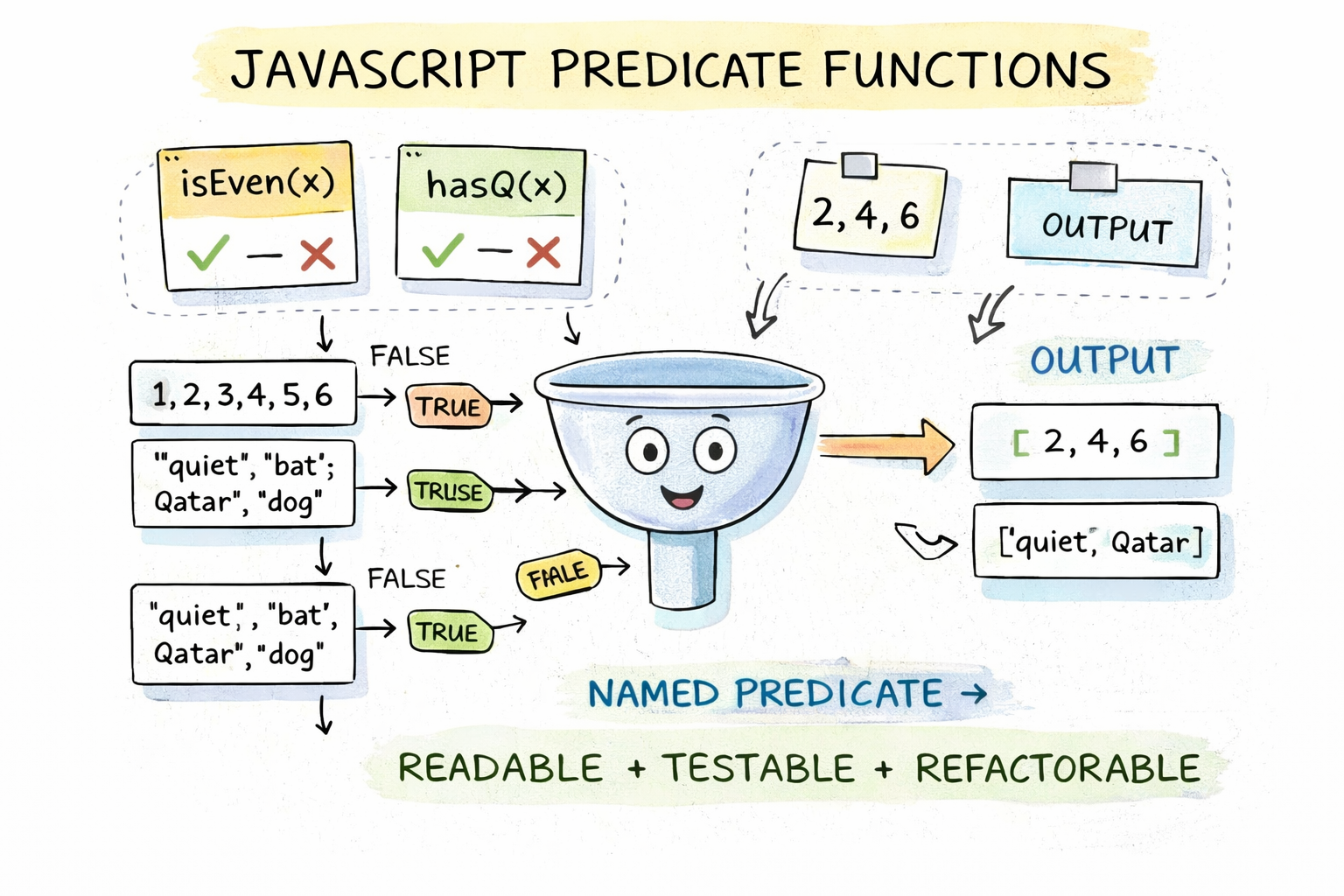
If you’ve written code in any programming language, you’ve already used predicate functions, even if you never called them that.
You already know this pattern, but naming it is useful. Terms help teams communicate ideas quickly. The moment you say “Replace primitive with object”, your teammate and your AI tool understand what you mean without extra explanation. The same is true for predicate functions.
This is why I decided to write this post: to give you a name for this common pattern and show you how it fits into the larger picture of functional programming and currying.
What is a predicate function?
A predicate function is a function that returns a boolean value true or false.
They are often used with Higher-order functions like filter, find, some and every to derive decisions based on the
data.
Let’s look at a single example of a predicate function used with filter:
// A predicate to check if a number is even
const isEven = x => x % 2 === 0;

// Using the predicate to derive a new array of even numbers.
const evenNumbers = [1, 2, 3, 4, 5, 6].filter(isEven); // [2, 4, 6]
Exercises
1. Write basic predicates
Write isEven, isLongerThan3, and hasQ predicates.
Show answer
const isEven = x => x % 2 === 0;
const isLongerThan3 = x => x.length > 3;
const hasQ = x => /q/i.test(x);
2. Use predicates with arrays
Use predicates to:
- keep only even numbers from
[1, 2, 3, 4, 5, 6] - keep only strings that contain
q(case-insensitive)
Show answer
[1, 2, 3, 4, 5, 6].filter(isEven); // [2, 4, 6]
["quiet", "bat", "Qatar", "dog"].filter(hasQ); // ["quiet", "Qatar"]
3. Refactor inline predicate to named predicate
Refactor this into a named predicate + filter:
const result = xs => xs.filter(x => /q/i.test(x));
Show answer
const hasQ = x => /q/i.test(x);
const result = xs => xs.filter(hasQ);
Checkpoint
You are ready to continue when you naturally extract inline boolean logic into named predicates.